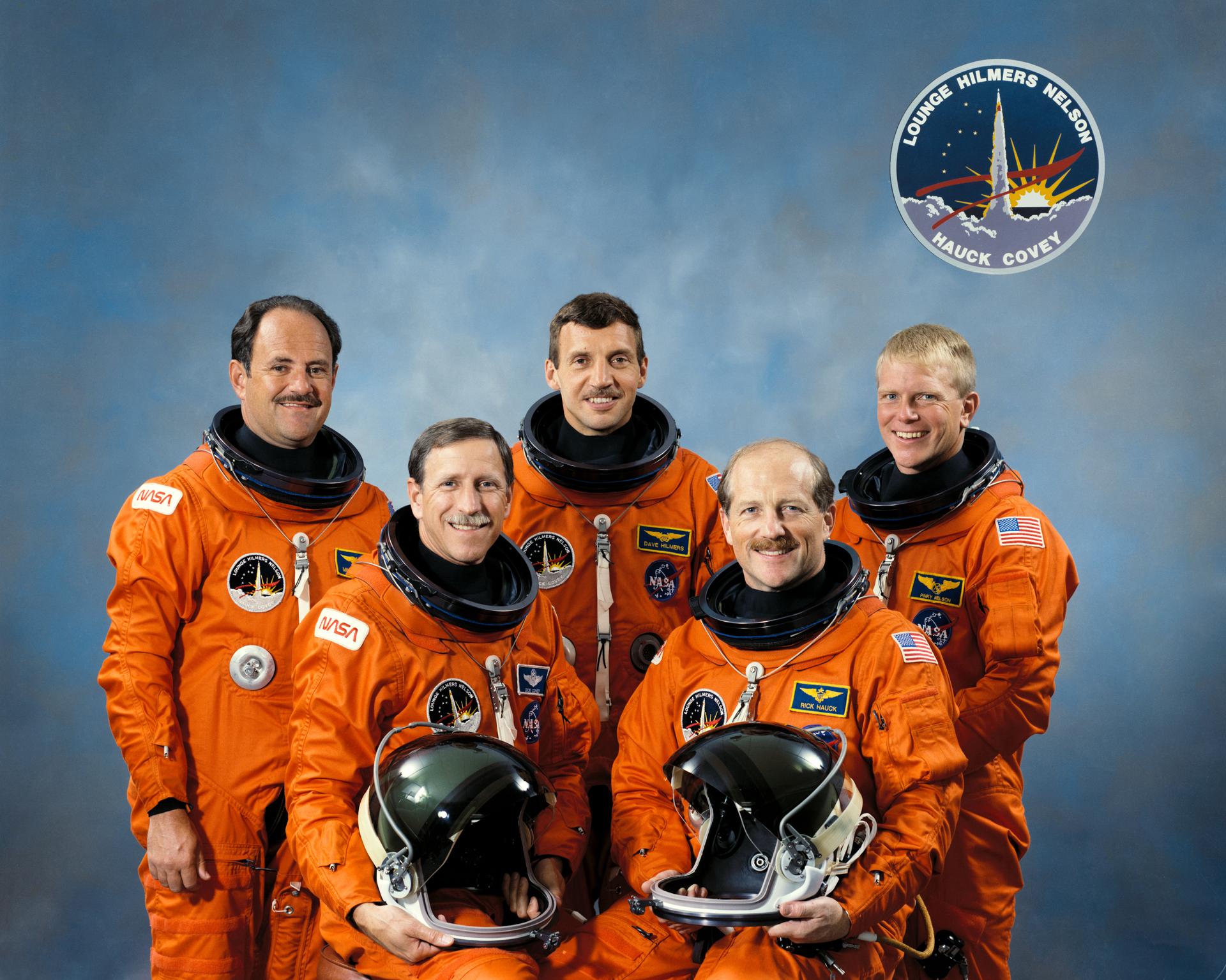
Hauck, Covey, Lounge, Hilmers and Nelson brought different paths and hard-earned experience to Discovery. Every member of the STS-26 crew had flown in space before.
Back, left to right: Mike Lounge, David Hilmers and Pinky Nelson. Front: Dick Covey and Rick Hauck. NASA / JSC, S88-47522.
01
Commander
Frederick H. “Rick” Hauck
A Navy test pilot with degrees in physics and nuclear engineering, Hauck joined NASA’s astronaut class of 1978. He piloted Challenger on STS-7 in 1983 and commanded Discovery’s STS-51A satellite-retrieval mission in 1984. STS-26 was his third spaceflight and second shuttle command. His return-to-flight crew brought together people with experience in spacecraft operations, satellite deployment and scientific work.
Covey trained as an Air Force fighter and test pilot and studied astronautical engineering at the Air Force Academy and Purdue. Selected by NASA in 1978, he first flew as pilot of STS-51I in 1985. He also served as a Mission Control communicator, including for Challenger’s STS-51-L mission. After piloting STS-26, he commanded STS-38 and the first Hubble servicing mission, STS-61. He later co-chaired the independent Return-to-Flight Task Group after Columbia.
A Naval Academy graduate with a master’s degree in astrogeophysics, Lounge served as a naval flight officer before joining Johnson Space Center. He worked on shuttle-launched satellites and the Skylab reentry flight-control team, then became an astronaut in NASA’s 1980 class. His first mission, STS-51I, included communications-satellite deployment and repair operations. STS-26 was his second flight. He later flew as flight engineer on the astronomy mission STS-35 and led the Astronaut Office’s Space Station Support Office.
Hilmers brought a background in mathematics, electrical engineering and Marine Corps aviation. NASA selected him in 1980; his first spaceflight was Atlantis’s maiden mission, STS-51J, in 1985. His ground assignments included upper stages and shuttle software verification. After Challenger, he worked on ascent aborts, payload safety and onboard software while preparing for STS-26. He went on to fly STS-36 and the International Microgravity Laboratory mission STS-42, completing four shuttle flights.
Nelson was an astronomer with a physics degree from Harvey Mudd College and a doctorate in astronomy from the University of Washington. Selected by NASA in 1978, he flew on STS-41C, which recovered and repaired the Solar Maximum satellite, and on STS-61C shortly before Challenger was lost. He also worked on spacesuit development and served as a Mission Control communicator. STS-26 was his third flight, adding satellite deployment and middeck science to his experience in orbital operations.