01 / JANUARY 28, 1986
The loss of Challenger
Challenger broke apart 73 seconds after liftoff on STS-51-L. All seven crew members were lost: Francis “Dick” Scobee, Michael J. Smith, Judith A. Resnik, Ellison S. Onizuka, Ronald E. McNair, Gregory B. Jarvis and Christa McAuliffe.
The accident began with a failure to seal in the right solid rocket motor’s aft field joint. The joint’s design and the unusually cold launch conditions compromised its O-ring seals. Escaping hot gas led to structural failure of the launch vehicle. Shuttle flights stopped while the cause and the decisions behind the launch were investigated.
02 / THE INVESTIGATIONS
A failed joint. A failed decision process.
President Ronald Reagan appointed the Presidential Commission on the Space Shuttle Challenger Accident, chaired by former Secretary of State William P. Rogers. Its work examined both the physical failure and how NASA and its contractors had assessed the warning signs.
The Commission found serious weaknesses in the launch decision process. Concerns about O-ring behavior in the cold, evidence from earlier flights and objections raised before launch had not been handled or communicated adequately. Its recommendations reached beyond the motor: independent safety oversight, clearer management responsibility, a review of critical hazards, better communication and realistic flight schedules.
The House Committee on Science and Technology conducted a separate investigation. It agreed on the joint failure but placed stronger emphasis on years of poor technical decisions and pressure to meet an unrealistic flight rate. The House also acknowledged the role of Congress and the Administration in creating that pressure.
03 / REDESIGN & READINESS
What changed before STS-26
Returning to flight required changes to hardware, its qualification tests, and the organizations deciding whether it was ready. Discovery received more than 100 mandatory orbiter modifications before the mission.
Solid rocket motor joints
A new capture feature restrained movement between the mating joint surfaces. Revised seals and insulation, an additional O-ring, leak-check provisions, heaters and weather protection addressed the failure mechanism. Five full-scale, full-duration static firings preceded STS-26, alongside component and simulator testing.
Main engines and orbiter systems
Main-engine improvements covered turbopumps, the combustion chamber, controllers, sensors and valve actuators. Orbiter changes included stronger landing-gear axles and brake improvements, thermal-protection changes and a latch to hold the external-tank propellant disconnect valves open during powered flight.
Crew escape and protective equipment
The crew wore launch-and-entry pressure suits. A jettisonable side hatch, parachutes, survival equipment and an extending escape pole added a bailout option during controlled gliding flight when a runway landing was unavailable. This was a limited escape capability, not protection against every ascent failure.
Safety oversight and flight readiness
NASA established an agency-level Safety, Reliability and Quality Assurance office reporting to the Administrator. The return-to-flight effort also reviewed critical items, hazards, launch criteria and operating procedures. Hardware testing and organizational changes were both part of the readiness case.
STS-26 press kit · Orbiter and propulsion changes, printed pp. 44–49 ↗
04 / SEPTEMBER 29, 1988
A working mission
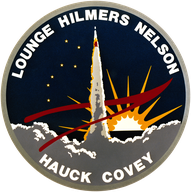
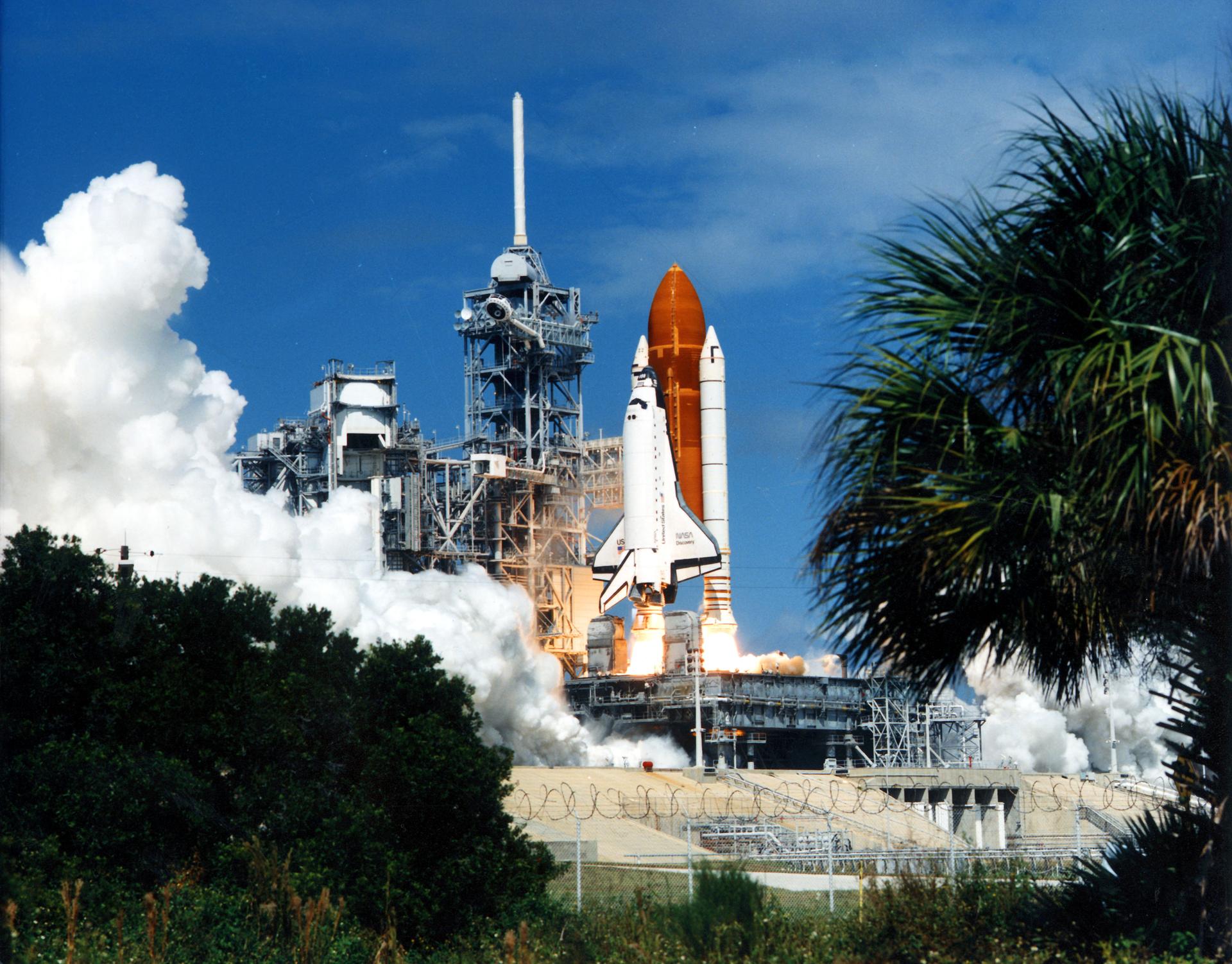
Discovery launched from Kennedy Space Center’s Pad 39B at 11:37 a.m. EDT. STS-26 was the 26th shuttle flight and Discovery’s seventh. Its five crew members were all spaceflight veterans.
The primary objective was to deploy Tracking and Data Relay Satellite C, or TDRS-C. Once operational it became TDRS-3. An Inertial Upper Stage carried the satellite from its deployment orbit toward geosynchronous orbit, strengthening NASA’s communications and data-relay network.
The crew also operated eleven secondary experiments, including protein crystal growth, materials processing, biological investigations and observations of Earth’s atmosphere. Two were student experiments. A separate instrumentation package, OASIS-I, recorded the vehicle’s environment during flight.
05 / OCTOBER 3, 1988
Mission accomplished. Crew home.
The crew deployed TDRS-C on the first day. Its upper stage successfully delivered it to the intended higher orbit, and ground teams checked out the satellite before it entered service.
The flight still demanded troubleshooting. A Ku-band antenna pointing problem raised the possibility of an emergency spacewalk if the antenna could not be stowed for entry; it ultimately stowed without one. A flash evaporator problem also affected cooling. Success meant completing the work while managing the problems that arose.
Before returning, the astronauts paid tribute from orbit to the seven people lost aboard Challenger. On October 3, Hauck and Covey brought Discovery to Edwards Air Force Base after 64 orbits. The mission lasted 4 days, 1 hour and 11 seconds. Postflight inspection found the redesigned booster field joints had performed as intended.
Discovery returned to Kennedy on October 8 aboard NASA’s modified 747 Shuttle Carrier Aircraft. The next flight would be STS-29. For STS-26, the immediate result was clear: the primary payload was delivered, the crew returned safely, and the shuttle had flown again.
NASA retrospective · Deployment, inflight problems, tribute and return ↗
NASA mission record · Landing and duration ↗
MEET THE PEOPLE WHO FLEWThe STS-26 crew ↗